
Underground Tanks vs Above-Ground Tanks
When you’re adding water storage to a property, one of the big decisions is whether to go with an above‑ground tank (the usual vertical or slimline tank you see next to houses and sheds) or an underground tank tucked beneath the surface. Each has pros and cons, and the right choice depends on your property, water needs, aesthetics and budget.
What’s Good About Underground Tanks
Space-saving and discreet
Underground tanks are hidden, which means no bulky tank dominating your yard or view. Great for urban blocks, landscaped gardens or properties where aesthetics matter.
Reduced effects of sunlight and temperature
Being buried keeps water cooler, inhibits light, and reduces algae growth. That helps water quality and often means less frequent cleaning or maintenance.
Ideal for small blocks or constrained spaces
If you don’t have much yard space, or you want to preserve garden or outdoor living areas, underground tanks offer high capacity without sacrificing usable land.
Potential long-term value for water security
For homeowners planning long stays or wanting long-term water supply, e.g. full-house usage, an underground tank offers a discreet, high-capacity solution.
The Trade-offs of Underground Tanks
Higher upfront cost and installation complexity
Excavation, specialised installation, back‑fill, compaction, and sometimes reinforced lids, all add cost. Installation takes longer and is more complex than above-ground placement.
Maintenance and inspection challenges
Inspecting, cleaning or repairing underground tanks can be harder, access is more complicated, and issues like leaks or sediment build-up may go unnoticed longer.
Not always easy to retrofit
If you’re installing on an established property with landscaping, decks, paths, or plumbing already in place, excavating for an underground tank may disrupt a lot of existing work.
What’s Good About Above Ground Tanks
Simple and cost-effective to install
Above ground tanks (poly or steel) are easier and quicker to install, require only a proper base, and don’t need excavation.
Easy to inspect, maintain, and upgrade
Access to fittings, cleaning, filters and vents is straightforward. If you ever want to add pumps, filters, or outlets, it’s all easier.
Flexibility in placement and sizing
You can choose slimline designs for narrow blocks, or big cylindrical tanks for large capacity. Adjust location as needed, even after installation if ground preparation allows.
Lower overall cost for many applications
If you want water for gardens, laundry, toilets or external taps, above ground tanks often hit the balance of cost, capacity and convenience.
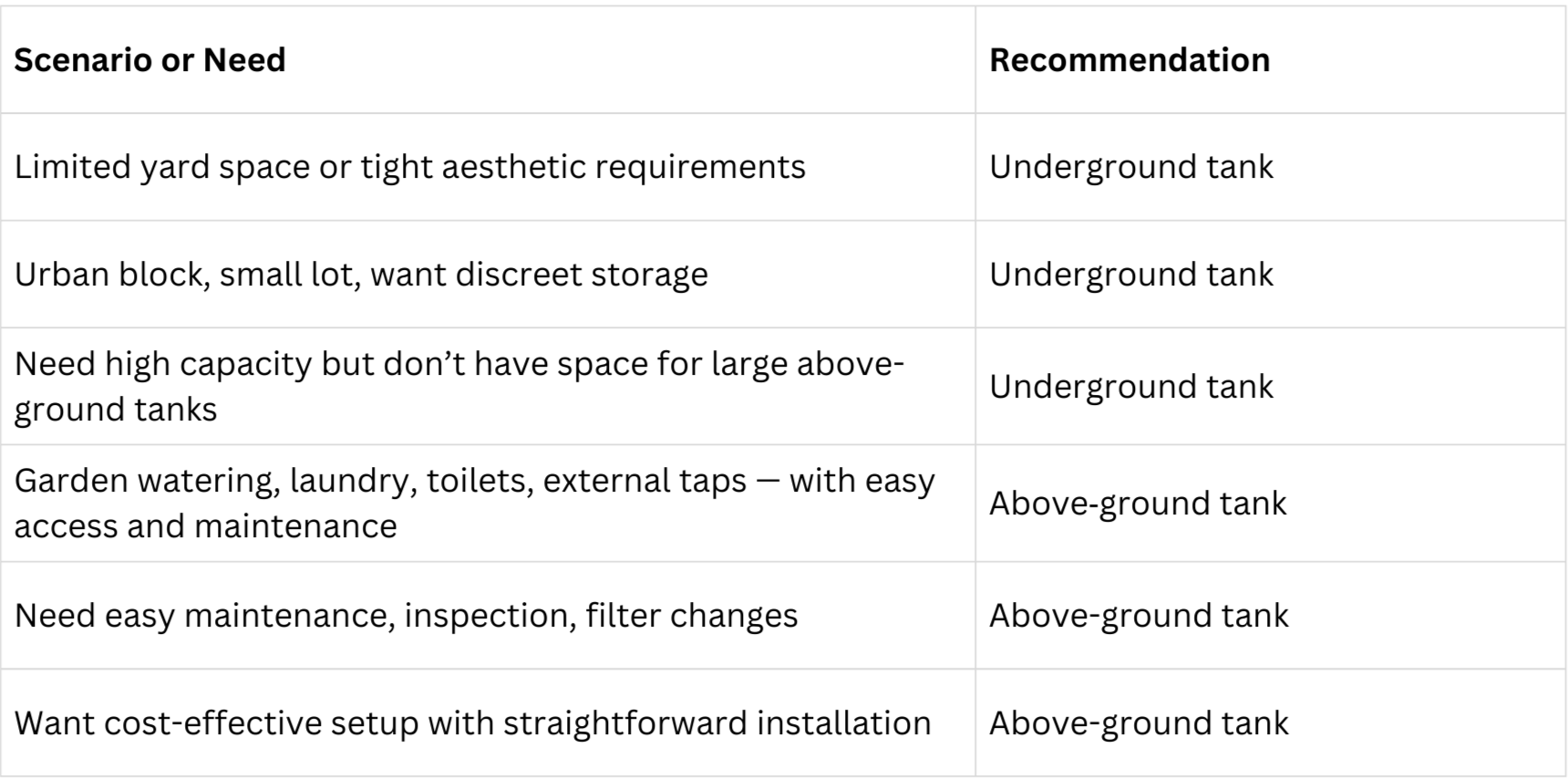
When Each Option Makes Most Sense
Questions to Ask Before Choosing
What’s your budget for tank and installation?
How important is unobtrusive appearance or yard space?
Do you plan to use the water mainly for external uses (garden/laundry/toilets) or internal household supply?
Is your site easy to excavate (no big rocks, stable soil)?
Are you prepared to handle maintenance or inspection difficulties with underground tanks?
Do you have good access for delivery and connections for above‑ground tanks?
How We Help With Underground or Above-Ground Tanks
For above-ground tanks: We assess base requirements, ground stability, and advise on placement for best runoff, catchment and access.
For underground tanks: We review site soil conditions, access and excavation feasibility, and can coordinate or advise on contractors if needed.
We help you weigh costs, benefits, long-term maintenance considerations, and likely lifespan for both options.
Neither underground nor above-ground tanks are automatically “better.” The right solution depends on your property, water needs, budget, and lifestyle. If you value discretion and have limited space, underground tanks are powerful solutions. If you want simplicity, easy maintenance and lower upfront cost, above‑ground tanks do the job, and often very well.
If you’d like a comparison and cost‑benefit assessment for your property, we’d be glad to help run the numbers and look at what works best.